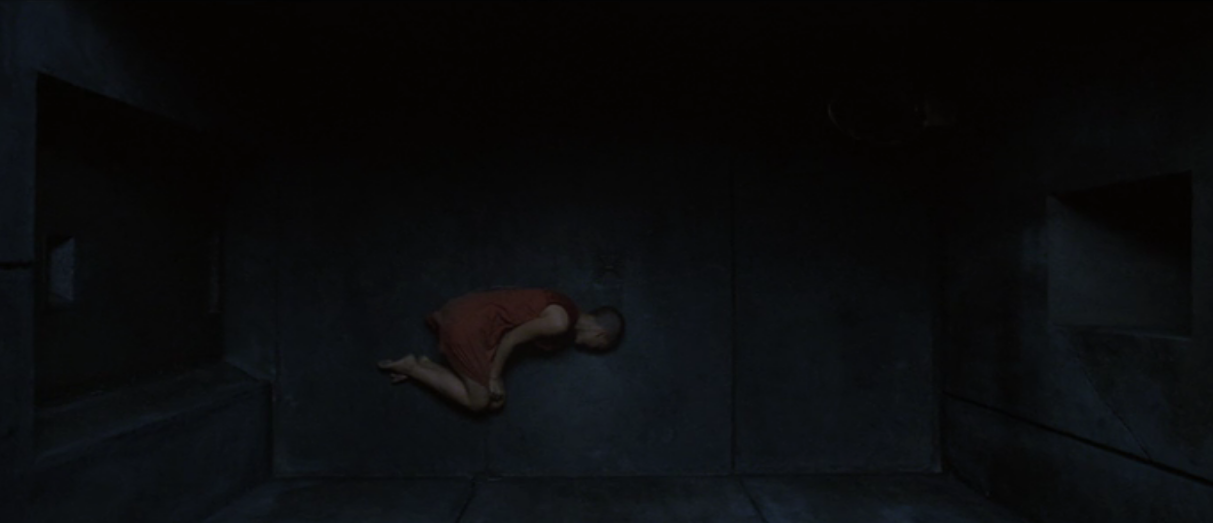
"for at the heart of melodrama is the principle that by virtue of suffering, one becomes good. It grounds this notion in a condition of moral purity that existed prior to victimization and is held out like a carrot throughout the plotline, promised back to the sufferer if her/his virtue can be reestablished through an act of heroic restitution that demonstrates moral might"
Friday, March 17, 2017
M for Melodrama
"for at the heart of melodrama is the principle that by virtue of suffering, one becomes good. It grounds this notion in a condition of moral purity that existed prior to victimization and is held out like a carrot throughout the plotline, promised back to the sufferer if her/his virtue can be reestablished through an act of heroic restitution that demonstrates moral might"
Thursday, March 2, 2017
Ali: Fear Eats the Soul


While there was clearly a switch in Emmi's behavior and "re-Germanification," was it her family and friend's non-acceptance that was the crux of the problem or Emmi's deep-rooted fear of being with Ali in general that caused her to push him away? Also, why is only his name in the title...is there a reason why he might be more of a main character than her?
Tuesday, February 28, 2017
“The Left may be dead, Joe, but the fear and hatred of the Left will never die. It’s an American passion.”
—Chris Bachelder, U.S.!
What are they implying by saying that the fear and hatred of the Left is an American passion? And in what ways does this represent the melodrama of the book (in terms of language).
—Chris Bachelder, U.S.!
What are they implying by saying that the fear and hatred of the Left is an American passion? And in what ways does this represent the melodrama of the book (in terms of language).
U.S.! NPR interview
Just thought I would post this quick npr interview with Bachelder on U.S.! I found it interesting to hear him speak on the book.
http://www.npr.org/templates/story/story.php?storyId=5257218
Thursday, February 23, 2017
Kleinhans in Landy
"In the bourgeoisie era, the family becomes the central area of personal life, a respite from productive life, from the alienated labor most workers must face."
The author begins the chapter discussing the modern failings of marriage (and that most marriages end in divorce, separation, etc.); however backtracks to discuss the domestic melodrama. Seeing that the vision of marriage has changed quite dramatically since this time, I would like to discuss the evolution of the domestic melodrama. How is it portrayed differently? (i.e. Friends with Benefits, No Strings Attached, movies with live in relationships that reject the ideals of a traditional relationship.)
Thursday, February 16, 2017
Poletta and The First Legion
"But since, "every coin has two sides, every argument has its opposite arguments," there is still plenty of room for ideological maneuver." (Poletta 142)
I would like to put this quote into the framework of the earlier discussion in the paper regarding activists and the church. I find it interesting to think that this could also be applied to religion. Oftentimes, the church in the past has found explanations of phenomena through religion while many scientists find evidence through the scientific method. Are these two things mutually exclusive?
Also, regarding the First Legion, I think it was interesting, at the time, to frame the movie through the eyes of an atheist. In this case, we were also presented with the skepticism of the miracle from INSIDE the church while the reverent belief is expressed by the disabled girl who is not a member of the order.
Tuesday, February 14, 2017
You're the Worst, Orange is the New Black, and Framing
“Effective frames are “empirically credible,” that is, they are consonant with what their audiences know to be true (Benford and Snow 2000). Those who articulate the frame should be credible as well (Benford and Snow 2000). Effective frames are, in addition, “salient” to their audiences. That is, they call on beliefs that are already strongly held. Frames also should be “experientially com-mensurable” (Snow and Benford 1992: 208; Benford and Snow 2000). They should resonate with people’s everyday experiences.” (Poletta, 489)
“Yeah, I’ve done that.” (Me, watching There is not Currently a Problem and thinking about clinical depression)
“Concerns about stories’ triviality, deceptiveness, and generalizability are more likely to be triggered by lower-status speakers than by higher ones. Indeed, higher-status speakers may be less likely to be heard as telling stories, rather than stating facts or advancing logical explanations.” (Poletta, 499)
Polleta, OITNB
Polleta Quote
"Certainly, one can challenge the conventions of narrative performance. Survivors could have told stories of anger on talk shows and could have recounted moving from shame to pride in courtroom hearings; but doing so would have been risky. Culture shapes strategy in the sense that abiding by the rules of cultural expression yields more calculable consequences than challenging them." Pg. 498
I wanted to highlight this quote because I think it is very relevant to what we have been talking about recently of why we relate to characters in films. Is it because we all have a little Darth in us, or a little Hitler? Maybe. But it's also because, as Nina said, the narratives we hear have been written and planned accordingly to their audiences. "Culture shapes strategy..." I wanted to specifically highlight this line of the quote because this is where stock characters come in. Different genres have different stock characters because each genre has its own conventions and its own culture that it must fit into. We it be okay to be laughing during a documentary about the concentration camps of Nazi Germany? No. Would it be okay to be screaming in horror during a RomCom? No.Orange is the New Black
This scene seemed to pop at me due to the very controlling and dominating language that was being used by the Officer Mendez but Burset doesn't let him have this moment; instead she takes control with her line "I don't do sausage in my breakfast sandwich." There is a conflict here between good and evil, as in any melodrama, the trick here though is figuring out who is good and who is evil. The black versus white contrast is very strong here so the first assumption we could make would be that Officer Mendez is the good and Burset is the evil- but then this scene shows us that maybe this isn't the case.
Poletta and Orange is the New Black
stories are better able than other kinds of messages to change people’s opinions
There should be a clear “we”—those to whom the injustice is done—and an obvious “they” who are responsible for the injustice (Gamson 1992; Stoecker 1995). Effective frames are “empirically credible,” that is, they are consonant with what their audiences know to be true
To probe the dynamic involved, subjects were asked to circle every “false note” in the story. The more absorbed they were, the less likely they were to see such false notes (Green and Brock 2000). This suggests that when they hear or read stories, audiences suspend their proclivity to counterargue, that is, to raise doubts about the veracity or rele- vance of the information they are hearing
Constraining and Persuading Narrative Elements in Orange is the New Black
- But telling stories is also risky, for at least two reasons. One is that people understand stories in terms of stories they have heard before. Stories that stray too far from the familiar risk seeming unbelievable, idiosyncratic, or simply strange.
- Even when activists have succeeded in creating a movement, and in gaining access to the venues where they can make their case, familiar stories pose a problem. Here, the problem lies less in the stories activists tell than the stories with which they are heard.
- This is where narrative comes in. Recent research suggests that audiences process stories neither centrally nor peripherally, but rather by a third route. They immerse themselves in the story, striving to experience vicariously the events and emotions that the protagonists experience. Green and Brock (2000) found that subjects who were highly absorbed in a story (indicated by statements like “activity going on in the room around me was not on my mind” while reading the story, and “I could picture myself in the scene of the events described in the narrative”) were likely to report beliefs consistent with those implied in the story.
44:14
Social Movements as Culture
"Narrative’s
power, in other words, is unevenly distributed. In this sense, culture may curb
challenge less through the canonical limits on what kinds of stories can be imagined
than through the social conventions regarding when and how stories should
be told."
Persuasion
"Yes, stories are powerfully persuasive rhetorical devices. The research in communication that we will cite shows convincingly that stories are better able than other kinds of messages to change people’s opinions." 487
-displaying different parts of society
-showing different POV
-controversial elements
-provoking viewers to question stereotypes and beliefs
-provoking viewer understanding
Monday, February 13, 2017
Poletta Reading and OITNB
In this reading, Poletta talks about the function stories and narratives have in promoting social action and change. It talks about how stories persuade, constrain, and what they are good for. One of the main focuses of the article is how viewers connect their own personal stories, as well as stories that they have already heard and experienced, to the stories they are hearing. This is both good and bad, it allows people who were not originally invested in a given topic to relate to it and possibly be motivated, but it is also risky. The risk lies in the fact that when an audience hears a story, it is up to them to interpret it and determine its validity. This happens based on the setting, topic and speaker of the story.
In "Orange is the New Black", Season 1: Episode 3, we are given some backstory into the life of the transgender prisoner at Litchfield. Throughout the episode, the reactions people have to her being transgender both in and out of prison are depicted through interactions both with and about her. It shows a range of tolerance, ranging from her wife, supporting her through her transition, to fellow inmates and guards making derogatory comments to her on a regular basis. There are also comments that refer to the general feeling people have about being gay, specifically about lesbians in this setting.
The show seems to be making a statement about how people view both transgender and lesbian individuals. By showing the background and personal story of a transgender person, the show seems to be using that narrative in order to provoke some sort of awareness in viewers.

Saturday, February 11, 2017
Narrative and Social Movements - Polletta
“They immerse themselves in the story, striving to experience vicariously the events and emotions that the protagonists experience… [and] when they hear or read stories, audiences suspend their proclivity to counter argue, that is, to raise doubts about the veracity or relevance of the information they are hearing. They truly suspend disbelief, and they do so in a way that has lasting effects. The attitudinal change brought about by stories tends to persist or even increase over time (Appel and Richter2007). Tell an absorbing story, this research suggests, and you can win people to your cause”
“The other problem lies in the norms governing how stories are heard and evaluated: when they are considered appropriate, believable, serious, and so on. Such norms are historical, but also institutional. This is why activists telling stories of their victimization have fared better in the media than in court. In the media, activists’ stories have been heard as those of “Every person.” Activists have been able to connect their own experiences to a larger normative point. In court, by contrast, storytellers have been expected to hew to familiar images of victims—passive, pitiable, and like all other victims—and then penalized when they have done so”
Thursday, February 9, 2017
Douglas Sirk: Written With The Wind
"In the strictest definition of the term, melodrama refers to those narrative forms which combine music with drama. Hollywood's use of background music to provide aural dimension and an emotional punctuation to its drama extends back even to the silent era. Live musical accompaniment (usually organ or piano) was standard from the earliest days of theatrical projection" Landy, 148 (Schatz reading)
"Ideally, the family represents a "natural" as well as social collective, a self-contained society in and of itself. But in a melodrama, this ideal is undercut by the family's status within a highly structured socioeconomic milieu, and therefore, its identity as a autonomous human community is denied-the family's roles are determined by the larger social community." Landy,153 (Schatz reading)
Question: How does the music of Written On The Wind play a role in the contribution to the overall 'melodramatic' ideals talked about by Schatz, especially that of the social community?
Schatz & Written on the Wind
"The audience was, on one level, shown formalized portrayals of virtuous, long-suffering heroines whose persistent faith in the American Dream finally was rewarded with romantic love and a house in the suburbs. Beneath this seemingly escapist fare, however, Elsaesser glimpses the genre's covert function 'to formulate a devastating critique of the ideology that supports it.'"
This quote reminded me of the part in Written on the Wind where Lucy and Kyle are first meeting, and Lucy says something along the lines of "I'll walk down the aisle and end up in a house in the suburbs with some children" and Kyle responds with "no, you are much too smart for that." This is a nice introduction to a critique of the American Dream/Romantic Love plot device.
Written on the Wind
"Ideally, the family represents a 'natural' as well as a social collective, a
self-contained society in and of itself. But in the melodrama this ideal is undercut by
the family's status within a highly structured socioeconomic milieu, and therefore, its
identity as an autonomous human community is denied-the family roles are determined
by the larger social community. The American small town, with its acute class consciousness, its gossip and judgment by appearances, and its reactionary commitment
to fading values and mores, represents an extended but perverted family in which
human elements (love, honesty, interpersonal contact. generosity) have either solidified
into repressive social conventions or disappeared altogether" (Schatz 153).
"The family's status is enhanced by its role within the community, whose economy and social climate it controls either directly or through benign neglect... the socioeconomic lifeblood of the community generates much of the tension" (Schatz 161).
Quote and Question: Schatz
Question: is Elsaesser suggesting that the American Dream is merely an illusion and exploited through film to give people a false sense of hope and security and catharsis?
"Elsaesser recently said that Hollywood's most effective melodramas would seem to function either subversively or through escapism--categories that are always relative to gthe given social and historical context."
The screenshot of my quote keeps on getting taken down, but I will have it in class.
Written on The Wind
Melodrama as Socioeconomic Commentary in the 50's
“First, it is a reestablished constellation whose individuals roles (mother, father, adult, adolescent, child, infant, and so on) carry with them large significance. Second, it is bound to its community by social class (father’s occupation and income, type and location of the family home, etc.). Ideally, the family represents a ‘natural’ as well as a social collective, a self-confined society in and of itself. But in the melodrama this ideal is undercut by the family’s status within a highly structured socioeconomic milieu, and therefore, its identity as an autonomous human community is denied - the family roles are determined by the larger social community”
Subscribe to:
Posts (Atom)